He must be the only person in my family who doesn’t underestimate or overestimate my knowledge base. People either consider me someone who reads a lot, or someone who knows nothing (because he’s not well-travelled). Nothing in between. But he takes me as I am. And there’s a reason why. This isn’t about just him or me but a human connection we all should have and should aspire to cultivate with others, with work, and with god (if you aren’t an atheist). A connection that, realistically, only a limited number of people are capable of.
I highly suspect my grandpa is neurodivergent. First I have to clarify what I mean by that. I don’t mean he’s a genius intellectually, it has nothing to do with intelligence. He shows the following traits:
- Extremely curious even in old age: he wants to know people, new tech, always asks about how people around him are doing. He wants to learn how to use a laptop at 87, even AI. And most of all, he wants to understand religion not as dogma but as an entire intellectual universe.
- Extremely well connected: he is intellectually connected to many people, handling a library and doing social work. His students still remember him (who are 50+ already) as guruji and still respect him for his teaching methods. So wherever he goes, he knows at least someone. And he did it without social media (or LinkedIn lol).
- Extremely sensitive towards people and himself: a lot of empathy for those below the poverty line. Many of his readings are about caste and religious oppression. He cries easily when something bad or good happens. His anger is widely known across his family and friend circle.
- Hyper-creative: why not just be a normal 87-year-old man and eat your meals and sleep? No. Because the creative mind refuses stagnation. I’m damn sure if someone can teach him guitar in Marathi with patience for his fingers to align, he might learn it and probably master it as well.
But there are other aspects of him which are slightly confusing if you look at them from a simple first-degree analysis. For example, he was telling me the story of Muhammad and how Allah took multiple tests during Muhammad’s life to check his heart. That’s how we got Abe Zam Zam, Bakri Eid. That’s why Muslims react the way they do and so on. In one such example Muhammad leaves his wife and son in a desert out of Allah’s wish. If the story is taken literally, it’s a clear case of schizophrenia, but I can’t tell that to my grandpa, can I? He was telling this story with enthusiasm and a warm heart, like a fanboy talking about his hero.
At this same moment, he had a magazine with the ANiS logo on it in front of him. He’s part of a group that follows Gandhian and liberal values and does social work for kids and adult learners. Isn’t this a dichotomy? How can someone be scientific and still believe in Muhammad’s narrative so literally? On the surface this may look common, but with him it’s different. He casually added to his story: this wasn’t a miracle, it was an act of god… as if god is a real ontological entity in his worldview and whatever he created is always real.
But my grandfather backs up his thoughts not with random conversations with some jackass maulana, but with decades of reading, comparative religion, and intellectual inquiry. For him, religious history is not fiction but an interpretive framework through which humanity has understood itself for thousands of years. My point is, he knows what he’s talking about. He’s not yapping like typical religious folks do. I genuinely suspect he must be among the top 1 percent of people who visit Hajj and actually know what they are doing.
And like I said, he’s the only person in my family who takes me as I am and doesn’t overshoot or undershoot me. A trait that is extremely important for the younger generation. Knowledge helps you estimate someone’s ability, but understanding people requires something more: emotional intelligence, exposure, and a willingness to see beyond your own worldview. For that you must meet multiple people and visit multiple places. One common complaint I hear about him (in his old age), and sometimes I complain too, is that he knows nothing beyond his bubble. But when you think deeply about it, that complaint collapses.
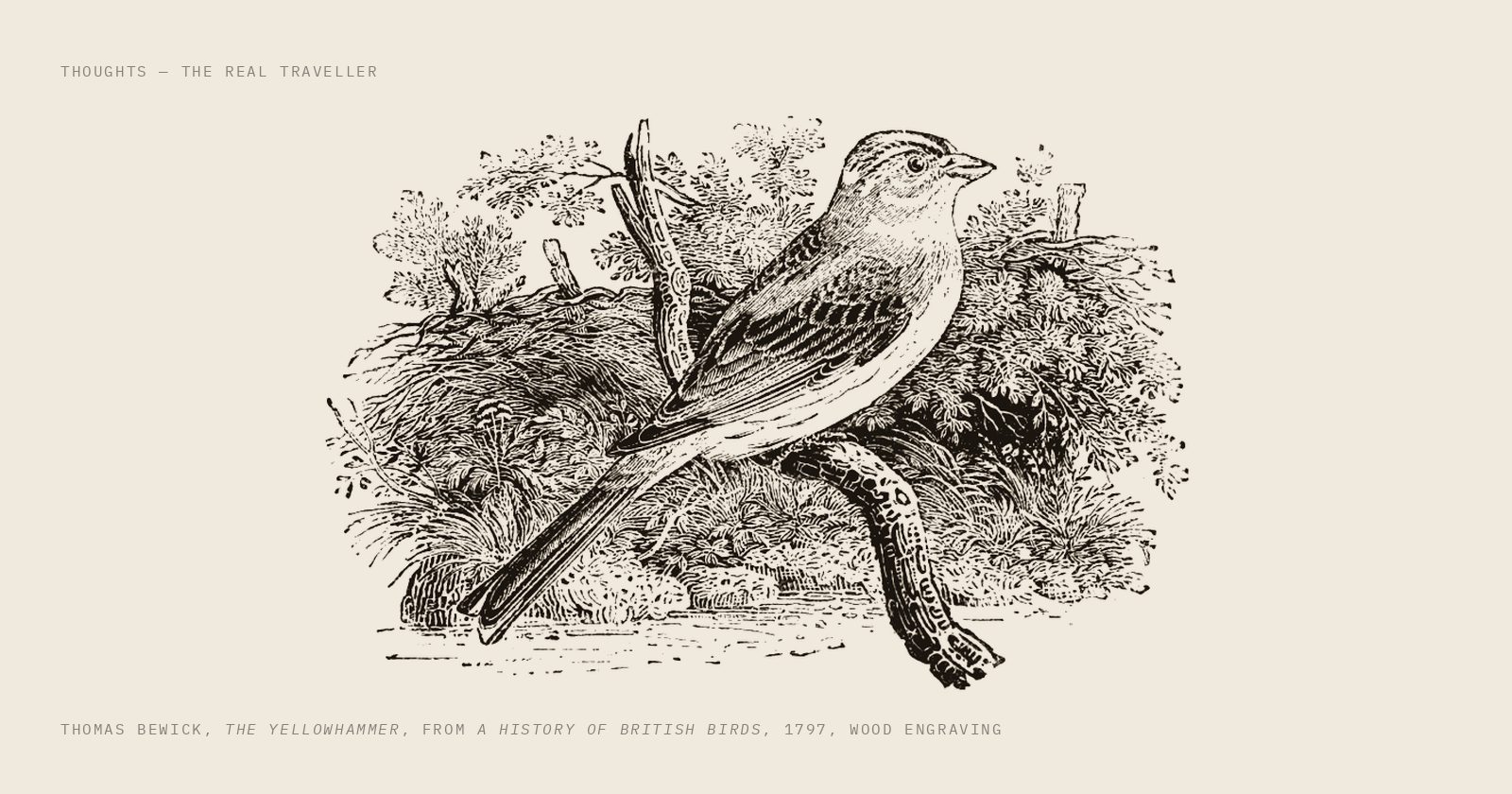
There are two layers. First, traveling isn’t just about seeing a new place. You visit a new country and see a bird on a branch and call it “wow what a beautiful bird.” That sight will give you a moment of enjoyment but it won’t last, because you’re not connected to the place, only to the memory. If you ask yourself: which bird is that? Which tree is it sitting on? Why is it here? Is it common or rare? Is it from this same area or did it migrate here like I did? The act of assembling these answers gives you a more sophisticated perspective on the place you’re visiting. You actually meet the people who live there and understand their lifestyle, not just their mountains and buildings. And the bird, obviously, is a metaphor.
That’s where my last point is: to have extreme curiosity about people and about places. Put my grandpa in a cab and I’ll change my name if he doesn’t ask the driver “kya naam hai aapka? Kahan se ho aap?” He wants to know everything about people and where they come from. It might sound annoying but I now understand the deeper reason. It may seem like he meets people from a limited area, but he knows them deeply and integrates himself into the place he’s living in. In a way he becomes the real traveler, and compared to some intellectual from 200 BCE, he has travelled the world.
Everything has a reason, even emotions. But more than that, every human should have a reason to live. Money, power, status are reasons too, but when you look at this 87-year-old brain you forget all that. Because you realise something deeper is lurking inside: the will to keep experiencing life. I’ve had this feeling whenever I’ve met people who are constantly engaging with the world, not withdrawing from it.
Sadly most of our society is created by heartless, hobbyless, curiosity-less, valueless and spiritually hollow but intellectually hyper-intelligent people. And there is no Reddit thread for someone like my grandpa to connect with others like him. I’ve not seen any other gene of his curiosity in my family. So when he sees me for who I am, I think he’s trying to tell me to be more like him and less like the noise around me. That statement is gonna sting me hard.