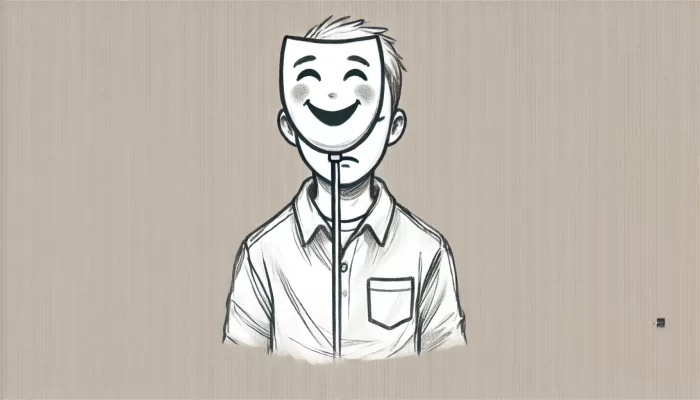
There's this weird intersection on one end, high-functioning autism (HF) individuals struggle with all the usual issues: not understanding social cues, difficulty processing emotions, trouble forming attachments, etc. But on the other end, they're smart enough to act "normal." And that just creates a truckload of problems.
A few months ago, before my mom even knew about my diagnosis, I asked her if she thought I had any difficulties growing up. Her answer was obvious No. She just said I was a crybaby but never to the point of concern.
Now, my mom isn't just some random person. She's been teaching kids for decades, did her master's research on gifted students, and has an interest in psychology, she's read multiple studies. She's educated, observant, smart and loving obviously... yet, she still couldn't tell I was struggling. Heck, "I" didn't even realise I was struggling until a few months ago. So it's not that my mom is to blame it's something much complex than that...
That's the thing, my suffering wasn't visible. If I struggled in subjects like languages or history but excelled in math and science, people just assumed, "Oh, this kid needs to work harder on those subjects". And that's exactly what happens to so many HF individuals. They grow up believing it's just a motivation issue, that they're simply not trying hard enough. But the reality is far more complex.
And I think this becomes even more pronounced in a country like India, where the system leans heavily on language. You are expected to read, write, memorise, and articulate across multiple languages at once. English, Hindi, sometimes a regional language layered on top. For someone like me, this wasn't just difficult, it felt misaligned. I wasn't simply weak at languages, I processed them differently. Reading was slower, writing felt mechanical, and comprehension demanded an invisible kind of effort that never translated into marks.
Part of this isn't accidental. It traces back to how learning itself evolved here. The traditional Vedic education system relied on oral transmission, precision, and memory. That made sense in a world where knowledge had to be preserved exactly as it was. But fragments of that structure still echo in modern schooling, where recall often outweighs interpretation.
The difficulty, however, is not with effort, but with alignment. Many autistic individuals do not engage with information through passive repetition. There is a tendency to search for structure, for internal consistency, for the underlying logic that holds things together. Without that, memorisation becomes extremely hard, sometimes even inaccessible. Because they can't memorise something which has no structure (there are exceptions here as well!)
At the same time, language-heavy recall introduces a different kind of strain. It requires rapid decoding, retention, and reproduction under constraint. For a brain already allocating additional resources to processing language, context, and instruction, this creates a compounded cognitive load that is rarely visible from the outside. This results poor grades, "lazy kids", distractions and in adult life, lack of self-esteem!
There are also overlaps with things like Dyslexia and other learning differences. If decoding itself is slower, or if working memory is already occupied with parsing meaning and context, then tasks like reading comprehension or written expression become multi-step processes instead of automatic ones like for 'normal' kids. So the kid is actually doing much more heavy lifting than it seems.
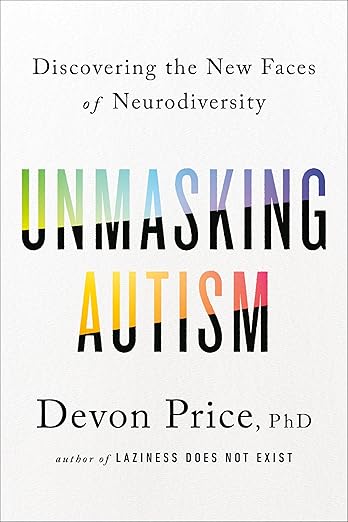
HF individuals need just as much assistance as any other autistic person. Just because they can read and write well doesn't mean they're "normal." They need human help too. But they rarely get it, because they don't ask. Because they don't even realize they should ask.
Also, autism itself is not a single, fixed condition. It is a spectrum in the truest sense. Different structures, different expressions, different costs. Some people need visible, continuous support. Some people appear completely functional but are quietly exhausted all the time. Some are intensely focused, some scattered, some socially withdrawn, some socially adaptive but only through effort. The variation is not a detail, it is the whole point. And that is exactly why people like me slip through unnoticed.
Like I said, even I didn't realise I was struggling. Because I never saw it as a problem. I saw it as my problem. I blamed myself for not fitting in, for struggling in certain areas, for not working hard enough, for failing exams, for not getting good ranks. I was oblivious to my own brain, my own emotions.
And this isn't just me... it's a common HF experience. I can't always tell the difference between being hurt and being angry. I'm 28 and still get excited over small things like a kid that sometimes people have to tell me to shut up. I shut down if I have to talk to more than three people at once. I can solve complex math puzzles but can't read the emotions on someone's face. I can create entire geographical maps in my head but still hesitate on right vs. left. I can't play team sports because it's just "too much information" for me to process at once.
So how did I never notice? Simple, I faked it! More accurately, I masked. Social situations don't come naturally to me, but with enough trial and error, I've learned how not to be weird around people. I've taught myself small talk. I've drilled right vs. left into my brain. I had to. It wasn't even intentional, it happened automatically because it was necessary. I was a crybaby but that only meant I was failing more than succeeding at this process initially.
But the brain is a limited machine. Scientifically, I use about 30% more mental energy just to have a normal conversation compared to neurotypical people. This constant masking drains me. Too much social interaction, and I shut down!
Now, imagine me as a kid, knowing nothing about neuroscience, having to learn the entire structure of human interaction on my own... without even realising my brain was wired differently. Imagine trying to make sense of a world that was never built for you, while constantly being told you just need to "try harder." That must have been painful. But I don't even remember it as pain.
There is also a nuance here that people tend to flatten. When autism and intelligence get mentioned together, it quickly turns into a stereotype. That's not what I'm saying. I'm not claiming that every autistic person is a genius, and I'm definitely not placing myself in that category. That's a misunderstanding of what a spectrum means.
And that's exactly why so many HF individuals slip through the cracks. We don't fit the stereotype of someone who's struggling. We don't look like we need help. So people assume we don't. Even we assume we don't. And that's how years go by, sometimes entire lifetimes, before we realise just how much of our energy has been spent performing instead of existing.
I was slightly lucky. It was late, in my late twenties but still, I stumbled into neuroscience, psychology and people who work in this area. I read, I researched, I asked questions, I found professional people, I found my answer. But not everyone does. And that's the real problem... because you can't ask for help if you don't even know you need it!
Note: The terms High-Functioning and Low-Functioning Autism carry problematic implications, which is why many now use Low Support Needs and High Support Needs instead. Also please don't be avoidant over autism or neurodiversity, at least 2% of the population is different from rest of us. That is more of a gift than curse.
I have been clinically diagnosed with Autism Spectrum Disorder (ASD level 1). This blog is purely for sharing my personal experiences and encouraging others to seek a proper diagnosis. I am not a medical professional, if you're struggling, please reach out to someone who is.