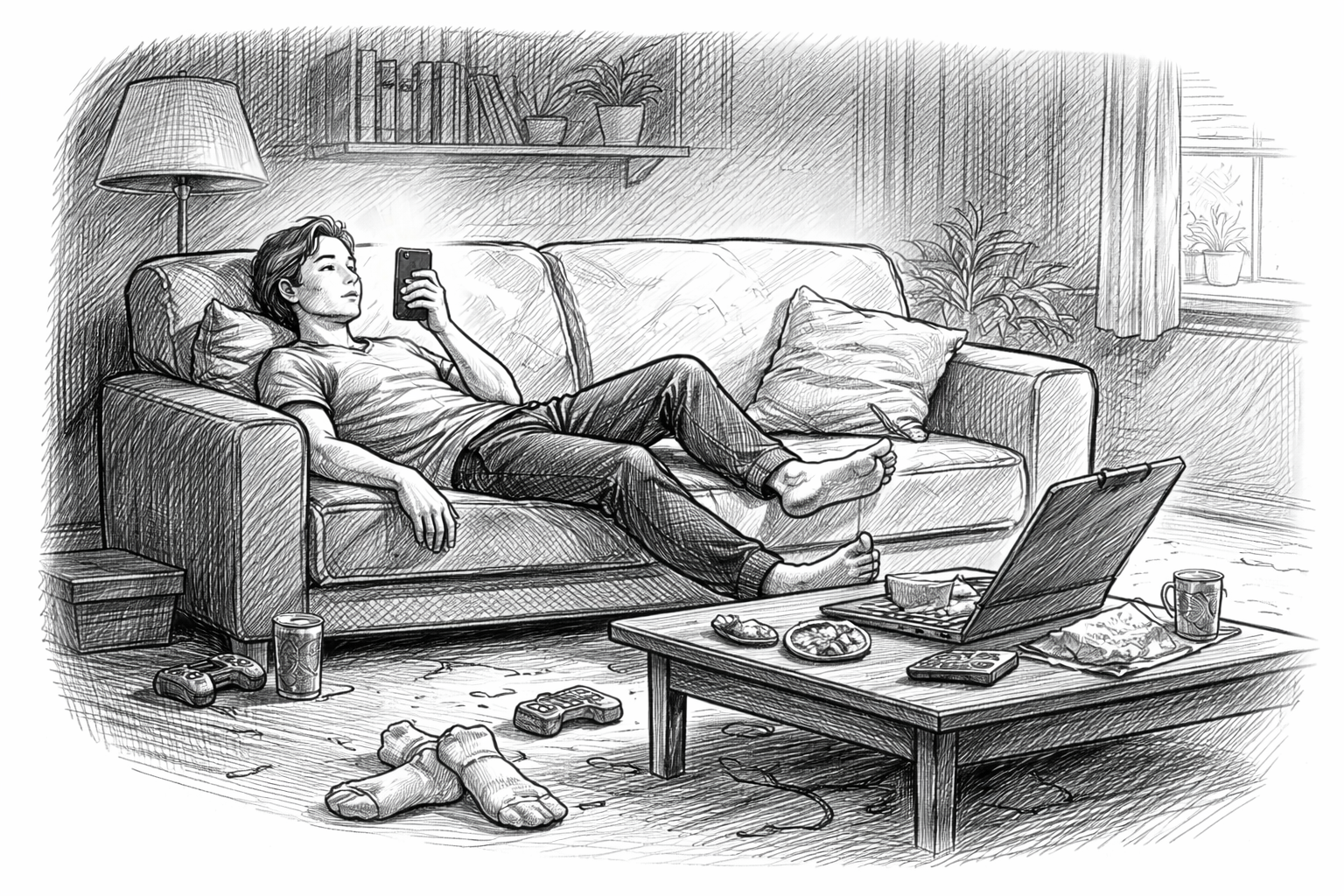
You are on the couch. Your phone is glowing. Someone from college is on a rooftop in Lisbon, mid-laugh, golden hour doing exactly what golden hours are supposed to do. Someone else is hiking a trail you saved to your travel board three years ago and forgot about. And somewhere underneath the scrolling, a quiet thought surfaces: if I had just done things differently.
It feels rational. It has the shape of self-awareness. But I want to push back on it, carefully, because I think that thought is not insight. It is a trap. And by the time you finish reading this, I hope you understand why.
Let us start with laziness, because that is usually where we end up when we interrogate our own inaction. We use it as a full stop. "I was just lazy." It tidies things up. It locates the problem inside us, which feels honest, almost noble in its self-criticism. But I do not believe most people are lazy (genuinely). If laziness were the dominant human trait, we would not have survived long enough to build the anxiety we currently feel about productivity. We are a species that, under the right conditions, works with extraordinary commitment. What we often call laziness is something else entirely: a nervous system trying to protect itself, a mind that has quietly calculated the risk of trying and found it too high, or simply a person caught in circumstances that offer no obvious foothold.
Comparison is an act of survival
Think about what actually happens when you choose social media over a workout. Both are offering you something. One is offering genuine physiological discomfort in exchange for a delayed, abstract reward. The other is offering immediate narrative, colour, social connection, and a neurochemical response that took engineers years to optimize. The fact that you choose the phone is not a character flaw. It is a completely predictable outcome given what each option is actually delivering. When we develop back pain and blame ourselves for not exercising, we are skipping over the entire architecture of why that choice was made. We compress a complicated system into a single moral verdict: shame. And shame, as it turns out, is not a great performance enhancer. It produces two weeks of compensation, followed by hitting a gym daily, followed by a collapse back to the original behaviour, now carrying additional weight for not being able to continue. This pattern repeats because we are diagnosing the wrong thing.
The same misdiagnosis happens when we look at the people who seem to have made it. The friend in the Ferrari, the colleague whose startup got funded, the person whose life appears, from the outside, to be going exactly as planned. We call them self-made. They often call themselves self-made. But that framing does not survive much scrutiny. It ignores the family that absorbed the early financial risk, the social network that put the right opportunity in front of them at the exact moment they were ready for it, the cultural context that made their particular skill legible and valuable, the basic biological luck of being born without the chronic illnesses or mental health conditions that quietly drain the resources of so many others. None of this diminishes what they built. It simply means that "self-made" is a story told in retrospect, one that smooths over every invisible scaffold.
And if there is no self-made success, there is no self-made failure either.
We rarely extend the same structural generosity to ourselves that we would extend to someone we love. When a close friend loses a job or a relationship or a year to grief, we do not say "you should have worked harder." We understand, instinctively, that circumstances shape outcomes. But when we look inward, we suspend that understanding entirely. We see only the choices we made, never the conditions in which those choices were made. We see the result, never the range of realistic options that were actually available to us at the time.
This does not mean we are removing accountability. It is about locating it accurately.
There is a third group, though, that is harder to name. Not the people who feel they failed, not the people who feel they succeeded, but the people caught in a loop. Chasing something, not quite reaching it, resetting, chasing again. And what I find interesting about this group is that if you ask them to describe what they are chasing, the answer is often something they decided they wanted a long time ago. A version of success or love or recognition that a younger self assembled from the available materials: other people's expectations, cultural scripts, a handful of formative experiences. They are still running toward a destination that was plotted when they knew far less about themselves than they do now.
We age faster than we revisit our own ambitions.
The 20 year old who decided what a meaningful life looks like was working with very incomplete information. He had not yet learned what kind of work drains him versus what kind of work sustains him. She had not yet understood what she actually needs from a relationship, as opposed to what she believed she was supposed to need. That younger self was doing the best they could, but they were essentially a rough draft. The trouble is we treat that draft as a binding contract. We continue organizing our present lives around a vision that our current self, if asked honestly, might not even recognize as its own.
This is where the real suffering comes from. It's not about laziness and the shame. But the quiet violence of trying to be someone that a past version of you invented, while your actual self stands to the side, largely uncontacted.
So what do you do, sitting on the couch, watching the reels?
The first thing is to understand that the problem is not comparison itself. Comparison is ancient and necessary. It is how humans have always understood where they stand, what they are capable of, and what is worth reaching for. The problem is what comparison does to perception. When you hold your life against someone else's long enough, you stop seeing your life as it is and start seeing it only as it measures up. The thing itself disappears. What remains is the gap. And a life experienced only as a gap is almost impossible to inhabit, because you are never actually inside it, you are always hovering at the distance between what is and what someone else appears to have.
The answer is not to remove the source. Deleting the app is avoidance dressed as discipline, and avoidance never builds anything. The shame will arrive through a different door, and it always arrives through a different door. The skill is metacognition. Letting the shame do what shame does, arrive, conclude, indict, and developing just enough distance from that process to watch it without becoming it. Not arguing with it. Just noticing it, and refusing to let it have the final word about who you are.
And the third, which is the hardest: let the old dream go, with honesty. It was built by a version of you that knew very little about what you actually are, and you have been chasing it long enough to know that the chase itself is exhausting you more than the not-arriving ever could. What sits on the other side of letting go is not emptiness. It is curiosity. The genuine, unhurried question of what your present self, with everything it has lived through, actually finds interesting. Not what would redeem the years. Not what would prove something to someone. Just what feels worth moving toward when you are no longer running from who you failed to become. That question, asked without urgency, is where a life that actually belongs to you begins.