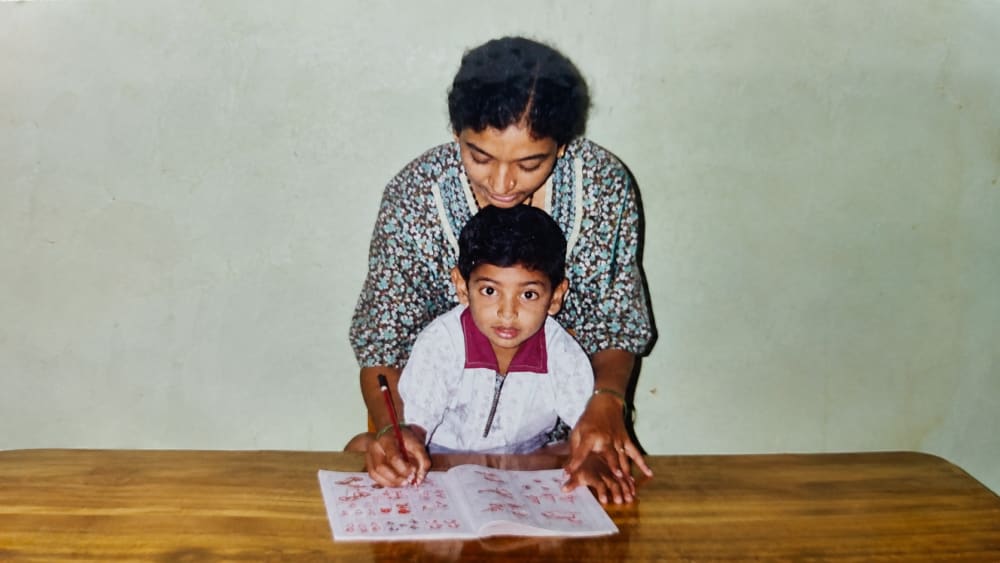
It is a crucial time in my life as well as in my mother's, and although the retirement is about her leaving a school where she taught chemistry for 32 years, it is also the end of an era for me, the leaving behind of a part of my life which shaped my childhood and in turn my entire existence, both emotional and intellectual. A school is an institution to everyone else and a geography to the child who grows up inside one, and the child does not get to keep the geography once the parent walks out of it.
Writing about a mother is complicated, especially when the bond is intense, and I think nobody should write about their mother unless they are either very good at handling their emotions or in possession of an extremely well crafted language. I am taking that risk anyway. This is about a mother who retired after 32 years of service, a teacher who taught her son and thousands of students how to "Be", and it is written in a rather third person view, because writing this as a son gets complicated and writing it as a student gets too logical, so I will refer to her as a mother and a teacher. The third person is a device of distance, and I am aware that choosing distance is itself an admission of how close the thing actually is.
A middle child
She is the product of two teachers, both of them fairly liberal for a Muslim household in a small town set near the highly fertile grounds of the river Krishna. In an environment which was fairly calm and a town which was mostly secular, her parents gave her and her siblings all the education they could afford, and were open enough to send their daughters to study in nearby cities at a time when women were not permitted to in the way they are now. Her father, who is also the single biggest influence on her, was shaped by Gandhian and Ambedkarite thought, and he planted the seeds of simplicity and empathy in her early. Gandhian simplicity and Ambedkarite dignity are not the same instruction, and anyone who takes both of them seriously spends a lifetime negotiating between renunciation and assertion, which explains a fair amount about how she carries herself. You can still see it in the way she dresses, in her dreams, in her aspirations, and in the things she wants to do after the retirement. Some inheritances arrive as property, and some arrive as a temperament, and she received the second kind.
She is a middle child, and just like every middle child she carries a tinge of neglect as well as rebellion in her. The neglect teaches you to observe, because observation is what you do with the attention nobody is asking for, and the rebellion decides what you eventually do with everything you observed. Being highly smart and slightly radical has always shaped her entire personality. She became not just the product of two teachers, a studious girl who followed them into the same profession, but also a free thinker with a high sense of morality, a trait I have always attached to being educated and not merely to being literate. Literacy is a skill the state can certify and education is a disposition it cannot, and she has spent her whole life behaving as though only the second one counts.
Her childhood stories mostly involve her siblings, how she lived alongside her slightly elder sister and took care of an extremely younger brother. What very few people understand about this dynamic is that it makes a person good at receiving the advice handed down by elders while also looking after those who follow her, without ever making them feel like an obligation. It also teaches you early that authority and care are two entirely different things, because you spend your childhood receiving one and supplying the other, and you learn which of the two actually holds a person together. A middle child learns to translate in both directions, and translation which later becomes a character.
As with every smart and individualistic child, the rebellion in her could not be fitted into that small town, and even though the household was fairly liberal, a liberal household is still a household, and it was not enough to contain a free thinker who wanted to be educated and not just literate.
A teacher
She started her "career" in teaching 32 years ago, when she was still unmarried. She has always told me that she wanted to be a lawyer, and that she probably would have cracked the UPSC and become a government officer. The dreams a person still names out loud decades later are usually the ones that came closest to being possible, which is exactly what makes them worth naming and what makes them expensive to name. And I think she could have achieved all of it, given her capacity for study, her intelligence and her sheer curiosity. But between her younger siblings' careers and the narrow field of vision that a small town offers, she never gave her own dreams much attention, and probably never gave herself much attention either. It is something she does not seem to regret in front of me, but I suspect a mind like hers would have wanted work far more difficult than explaining the basic concepts of chemistry to fifteen year olds. Though I have started to doubt whether difficulty is even the right axis here, because a courtroom would have handed her a harder problem and a much smaller one, and thirty two years of adolescents is not a smaller problem at all.
But a mind like hers was never going to stop at a job which did not fulfil it entirely. With her curiosity and her rebellion she could turn even a mundane job into a life of purpose and excitability, and she did. As she has argued with me, probably millions of times, "a teacher's job is not easy, you see a new student every day! It is not about teaching the same subject for decades, it is about tackling different students every day!". These are not the words of a teacher who does the job for the sake of it, or to get a little money out of her students' pockets. She genuinely cared about most of them. Most, and not all, because a teacher who claims all of them is either lying or has stopped paying attention to the individual ones. The training for that care was done by her younger siblings, and later by me. She understands students better than most teachers do. She reads the full spectrum of emotion rather than the narrow band that most teachers (the ones I have faced, at least) use to judge a human being, which is how studious they happen to be. Studiousness is the easiest signal to read and the least informative one available, which is precisely why entire institutions are built to run on it. Her interest in psychology is the evidence that what drives her is curiosity, and not a search for validation or respect from her students.
She has taught chemistry for more than thirty years, and although I would have liked her to be consumed by her subject, to go into its depths for their own sake, the job never required her to be a researcher. She used to teach fifteen and sixteen year old students, who are mature enough to understand that there is more to life than passing an exam to enter the next grade, and immature enough to be badly equipped for a life of actual freedom. So the job of a teacher is not just to teach them what is written in their textbooks but to let them know that the freedom they are seeking is not going to be easy to navigate. And having only two years under her belt in which to mould a student, the work gets slightly more intense than it is for a college professor or a high school teacher (both of whom get around four or five years to shape a child). Two years is short enough that she could never afford to wait for a student to become interesting, so she had to assume in advance that they already were, and that assumption, made every year for three decades, is a kind of moral position. See? As soon as you remove the money and the "career" from the equation, the job stops being a duty you have to perform and becomes something else entirely.
With the determination and empathy she picked up early in her childhood, she became a teacher who taught thousands. Most teachers would value themselves based on the number of engineers, doctors, or even top level mathematicians they have taught, but with her style of teaching I think the correct measure would be different, and it would be how many lives she changed by giving even the poorest and "dumbest" student in the room a space to explore and to ask questions, both about the subject and about their personal lives. That measure has no register, and no felicitation ceremony can read it out loud.
A mother
As I unpack her different aspects, it is important to unpack her mother aspect as well. Parenthood is not only about how you learn to raise a child, it is also about how you yourself were treated as a child by your own parents. So every parent works with two sets of instructions, the one they have decided to follow and the one that was installed long before they had any say in it, and most of the difficulty lies in telling the two apart in the moment. Based on my observations of her family, her parents are radically liberal and morally strong at the same time, mostly raw in the way they express themselves, and they have been subjected to extremely emotionally brutal situations. The combination of this can go either way. It can create a household which places too much value on education and on the paper form of knowledge, which creates a world of empathy and a genuine respect for society, but which also creates emotionally stagnant and undeveloped personalities. The same rigour that makes a family morally serious can make it emotionally illiterate, because both of them grow out of the same conviction, which is that feelings are a lesser category of thing than principles. Appreciation of any kind is really hard to come by in this family. Perhaps because the family carries the same inherited trauma that has been passed down through generations in many Muslim households in this part of the world. Trauma of that vintage does not announce itself as trauma, it simply settles into a household as a standard of behaviour, and nobody living inside it has a name for what they are following.
As an emotionally active human being it must have been slightly more complicated for her than for her siblings, who I suspect are much less rebellious about their emotions. It is not so easy for her to say "yes" to everything her parents think, and at the same time she is far more emotionally mature than most of her family, so it takes a toll on her to explain her own ideas in an environment which does not really have the bandwidth left to accept novelty. And a person who has to keep translating herself for her own parents will eventually become very good at the translation and very tired of the fact that it is still required. It is pretty evident in her own personality that she is still extremely affected by how her parents think of her, and equally evident that the rebellion in her still pops up every now and then whenever it gets a chance. Both things are true at once, which is usually how people actually are.
As she was passing her rebellion and curiosity through her genes into me, she also passed down some of that imposter. That is the cruel arithmetic of inheritance, because you do not get to select which traits travel, and the imposter comes in the same package as the curiosity and probably in the same envelope. She is and will always be an outlier, but she could never rebel enough to actually show it to her parents, and although she became a formidable teacher with uncommonly high levels of morality, she probably feels like she is not as accepted as the others in her family who followed the well trodden path and achieved stability without much questioning of their existence.
Her son too has always felt like an outlier, in almost every aspect of his life (partly due to his neurodivergence), and she could critically understand the exact feeling in him that she had felt throughout her own childhood. She tried to break that imposter in herself through her son, and the imposter did not break that easily. But the fact that I can actually sense that imposter in me and in her, that I can trace the emotional neglect running through an entire generation of her family, is itself the evidence that she did a better job than what was expected of her. Naming a thing is not the same as being free of it, but a generation that can name it has already done work that the previous one could not. I can see the pattern breaking between me and her. Patterns of this kind do not break cleanly, they break by a degree per generation, and a degree is enough. I think she became a mother like the mother she had always seen, but unlike others, she evolved as a mother over the years. I think the breaking of that pattern is the result of her willingness to question herself, her parenthood, and everything that was taught to her. A trait which is useful not just for a parent but also for a teacher.
After retirement
As someone intellectually gifted and rather consumed by society and by her obligations to it for years, she now has the freedom to explore the things she always wanted to but never got a chance to. As someone emotionally empathetic and progressive in her own sense, she now has the chance to build for others the things she always wanted to have for herself as a kid. That is usually how these things work, because the deprivation quietly becomes the design brief, and the people who build the warmest rooms are the ones who once stood outside them. She reads, but I want her to read "a lot". Reading has been a tool for her for thirty two years, and I want it to become useless to her now, which is the point at which it actually starts working. She is a rebel, but I want her to inhabit that rebellion instead of storing it. After looking at her, I can sense that it is finally her time to break that self image of being for someone, and to build an image of just being.
There are many ways to retire. Some people still continue to do other jobs, either because they like it or because they still lack money (by greed or by financial struggle). I do not wish a lack of money on her, ever. But I also do not want her to chase that exact path again, the one where novelty is not accepted. Retirement is a word invented by people who think of work as the content of a life rather than its container, and she has never quite been one of them. I wish her a life which starts at sixty rather than one which concludes there.
As someone who has an interest in people, she remains the most interesting one available to me. The challenge for her is to sit still long enough to finally accept that sheer curious, hyperactive, mostly rebellious girl beneath all of it. Sitting still is the harder discipline, because a life spent being useful teaches you that stillness has to be earned, and nobody ever tells you when you have earned it. To project herself as a being and not just as a teacher or a mother. It is time for her to leave the nest, and to finally learn how to be free!